
A War for Words
Part I: How words lose meaning

In “Politics and the English Language,” George Orwell makes the argument that authoritarians seek to control language and reduce its complexity, to limit the tools people can access to express critical thoughts and to simplify language overall, winnowing a multi-hued palette of expression down to good and evil, or in Newspeak, the fictional language he portrays in his more famous work, 1984, double plus good and double plus ungood.
Today, it is especially relevant to develop this argument further, as we are ruled by someone who can’t string a full sentence together and who is a foremost representative of the ascending idea, backed by powerful institutions, that research, accuracy, honesty, and even having a fucking clue about where we come from and where we’re going, just don’t matter.
In this three part series, I want to look at language, history, and our ability to talk about what ails us.
Part I will get into some technical linguistics. If you’re not up for that, then check out the much more meditative missives from Alex Gorrion, on “Saying Goodbye” and how it relates to a spirituality of distance, travel, and leave-taking, and “You Don’t Really Care for Music, Do Ya” on babies, music, and language-learning (anyone out there work with The Anarchist Library? these two should get uploaded!). Then tune back in for Parts II and III in the coming weeks.
Help one of my favorite radical bookstores and community spaces in the world, Firestorm Books in Asheville, North Carolina. Apart from being a cooperative that offers an excellent selection of books, Firestorm was a hub for mutual aid efforts in the aftermath of the climate storm, Hurricane Helene. You can support them through this link, or order some books off their website
I’m going to start small, seemingly petty even, with a goal of going big. But I promise I’ll do my best to facilitate a steep learning curve.
Wait, I’m going to make this harder to comprehend?
No. As those of you who are ahead of the curve know, a steep learning curve means a process that requires a small amount of effort or time to achieve the desired level of learning. How is that so? The metaphor is originally a reference to this kind of graph, which measures time, effort, energy, or some other expenditure along the X axis, against result achieved along the Y axis.
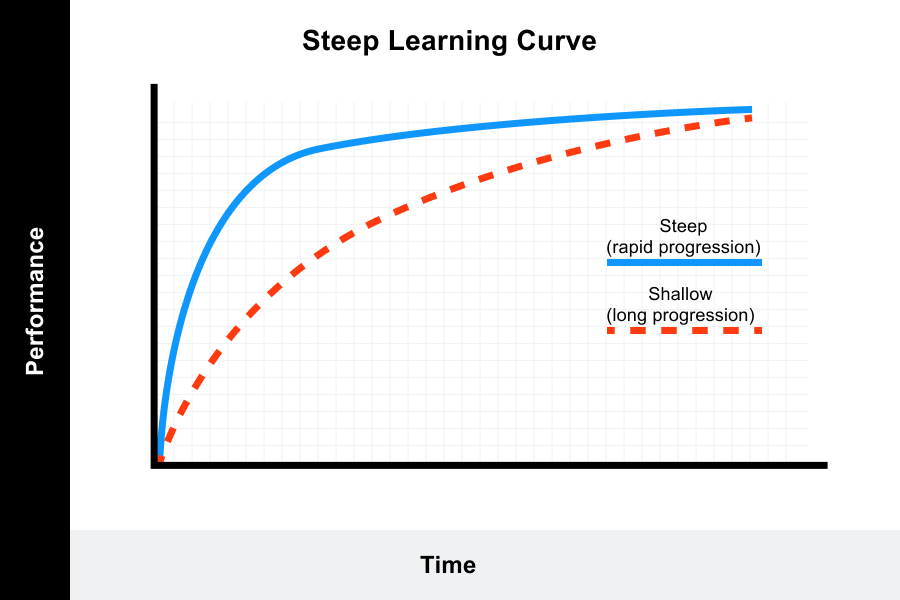
The farther you go from left to right, the more time or energy you’ve put into learning. If there’s a sudden jump from the bottom of the graph to the top of the graph—a steep learning curve—that means a small amount of effort produced a huge amount of learning. The thing was easy to learn. If instead what we see is a very gradual learning curve, that means our students have to dedicate a lot of continuous time and energy to increase that learning and get their educational results higher up.
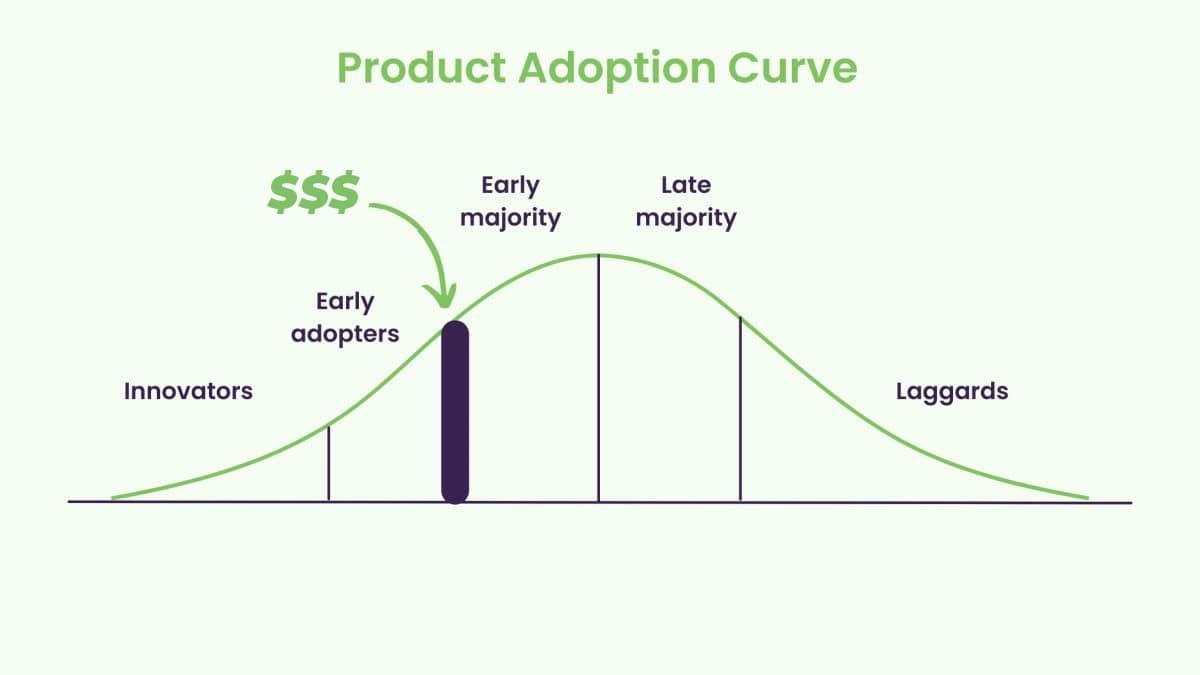
What about “before the curve?” That’s a reference to the kind of graph that depicts a certain amount of change happening very gradually. and then all of the sudden there’s an exponential change. Imagine every tiny step up is another person figuring out a puzzle. If you’re “ahead of the curve,” that means you figured out the puzzle before this big sea change in which the majority of people, in a short period of time, figure it out. If you’re behind the curve, maybe that means you just need a different teaching style, you need more practice with puzzles, or you’re more interested in dedicating yourself to other forms of intelligence.
Whether we use our metaphors correctly or incorrectly might just come down to the teachers we’ve had, the articles we’ve read, the conversations we take part in. After all, no one knows everything and everyone makes mistakes. But the more time we spend thinking about language, what it actually signifies and where it comes from, the less likely we are to use clichés or misuse metaphors, and the more likely we are to learn about the world and the interconnectedness of so many forms of knowledge. An awareness of language helps us spot attempts at manipulation or distortion, and gives us more opportunities to create a honed, nuanced analysis of the world that is also historically rooted.
The downside is, reading the press, especially the media that consider themselves literate becomes especially frustrating. The Guardian writes Isis instead of ISIS (which sucks even more for the Nilotic goddess) and Nato instead of NATO, even though ISIS and NATO are freakin acronyms, which literally means “high name” or “name in the heights” i.e. it’s a word in all caps, made from initials. Then there’s The New York Times, the enemy of decent people everywhere: not only are they in serious need of a proofreader, they have been pushing the ridiculous convention of “well-” as in well-informed or well-educated. Though the editors at the NYT might still think that an adverb is a word that ends in ly, actually it’s a word that modifies adjectives (or verbs or other adverbs or verb participles that act as adjectives). “Well” doesn’t need a gawl-durned hyphen because its whole purpose and function is to modify adjectives. “Well-educated” shows about as much awareness of grammar as “diligently-working” or “the-overpaid-editor” for that matter. (Embarrassingly, I almost left “its” two sentences back as “it’s,” and I’m sure this newsletter has as many typos as the average NYT article, but srsly, they get paid and have a large staff. I don’t.)
This might initially-seem a stretch, but I think there is or can be a connection between a lack of awareness of the mechanics of language, and a lack of critical thinking.
This essay is about to get very technical, but I want to show how important these linguistic questions can be with a few dreamy—and saucy—examples.
As I was learning Catalan, I realized that the root meaning of the word vulture probably relates to this bird’s habit of turning lazy circles in the sky. In Catalan, voltor can also be literally translated to “one who turns.” The dominant etymological hypothesis links “vulture” to the Latin “vellere” (meaning to pluck or tear), but far more defining of a vulture is not how it plucks out an animal’s insides, the same as many other carnivores: it’s the way it flies. And the modern Catalan word is almost identical to the older Latin word, voltur. And in Latin, volvo means “to roll” and “-tor” is a common suffix for one who does something (similar to the -er in “writer,” “dancer,” “singer”).
Language histories can also tell us about social histories: in nearly every language in the world, the word for tea is very similar to either “tea” or “chai,” which reflect two paths of language transmission, both of them colonial. The Dutch spread thee from Malay, who named this leafy plant teh in accordance with the dialect (t’e) of the Chinese people who passed it on to them, whereas the Portuguese got into the chai trade through their colony on Macao, where they learned about the drink in Mandarin, ch’a. And the Chinese, for their part, probably adopted their word from a conquered and now extinguished neighboring society in the southern part of their empire.
What other controversies hide in our vocabulary… Did you know that most people in the US and the UK misuse the words “Left” (as in the political left) and “performative”? Each of those words have very specific origins, and anarchists, anticolonial freedom fighters, and radical queers in particular could really benefit from learning that history… and resisting the slippage in meaning. I’ll get back to that in Part III of this series.
Language! Who said it was boring?
Alright everybody. Recess is over. It’s time to go deep nerd. I want to cover word smooshing and transglottal redundancies… before I get to Words Killed by Capitalism and Words Lost and Stolen, which will come out as future essays.
Transglottal redundancies
You know what? Let’s start with transglottal redundancies, since they’re easy and fun. Transglottal redundancy is a technical term which I did not invent. I swear I learned it when I was getting my Linguistics PhD at… college in… Languedoc, France.
It just means a redundancy that happens after a word is adopted into another language and then used by people who don’t know what the adopted word actually means. (Transglottal is a word I stitched together that just means “across tongues.”)
A common example of a redundancy is ATM machine. It’s redundant because you’re saying Automatic Teller Machine machine. (Teller, now there’s another endangered word with a long history, though I certainly won’t mind if banks go extinct.)
Now let’s get transglottal: chai tea, of course, is redundant, since chai means tea. By the same token, though, “Milky Way galaxy” and “pita bread” are also redundant as any Greek speaker can attest, as is “Sierra Madre mountains” or “Sierra Nevada mountains.” And let’s not forget “guerrilla warfare,” since it basically translates to warfare of asymmetric warfare. Also, “guerrilla” in English is used wrong: the word refers to the type of warfare, whereas “guerrilleros” is how you talk about the people fighting it. My proposal: let’s get Catalan and say “guerrillers,” since English already uses -er as a suffix to refer to the people who carry out a certain activity (see “tellers”).
A final example, “splitting the atom” is a bit of a paradox, since a-tom means something that cannot be cut, but I think it’s a good paradox as it conveys the impossibility of what scientists set out to do. And their particular quest is an example of how science is not politically neutral, how even progressive or antifascist scientists might end up responsible for atrocities.
Word smooshing
Word smooshing is another technical term. It describes the process by which different words get their particularity and nuance smooshed out of them until they’re not only synonyms, they’re interchangeable. The result is that words have less meaning, and we have fewer tools for constructing complex analysis.
Let’s consider the words job, work, profession, and career. Fortunately, each of these words still retain different nuances. Around when it appeared in the 1500s, “job” referred to a task or piece of work, settling definitively into a paid gig as wage labor became more widespread in the 1600s. “Work” is a fascinating one, referring to a deed or action in Old English (weorca, pre-1066), and to physical, scholarly, or artisanal labor in the 1200s. The same root can be found in the Proto-Indo-European word *werg- which goes back at least 4500 years and means “to do.”
The latter two words connote a higher income bracket, with “profession” suggesting skilled labor or the kind of white collar hustle that requires a lot of formal education, and “career” suggesting the sort of lifelong job security the poor and precarious simply don’t have access to. Both of these shades of meaning hold true to the linguistic origins of these words. A profession stems from an educational path or apprenticeship that you profess or pledge yourself to, like declaring a major in university. “Career” still retains some sense of a course, road, or race. I wonder if the generations who developed the word were also thinking about a “rat race”!
But what about vocation? Until recently, this word meant “a divine calling,” as in the purpose of your life or the talent that God, the Gods, or the spirit of the world wanted you to cultivate. (The words “vocal” and “voice” are related to vocation.) Nowadays, “vocational training” is on offer from Burger King and AT&T and almost no one thinks about a vocation as a higher calling or purpose. It’s just another job in a job market that offers employment opportunities that are generally exploitative, meaningless, and soul-destroying.
Here’s an even clearer example of how institutions and economies can destroy shades of meaning, or—to use the proper academic term—smoosh words. In Manhattan, one of the oldest surviving cities in the US, founded by Dutch colonizers in 1625, the words street and avenue have different meanings, at least minimally, because streets run east and west, and avenues run north and south.
But the urban and suburban expansion of the US economy’s profitable real estate sector—and it’s easy for them to profit when the basis of what they’re selling is legally stolen, first through colonial conquest and later through the intentional cycle of redlining and gentrification—has led to real estate developers and growth-hungry city planners naming streets according to their own simplistic whims. Nowadays in the US, street, road, avenue, lane, trail, and drive, all mean the exact same thing, whereas in the suburbs place, circle, and court are tossed about regardless of their dimensions. On any street sign, all of these denominations are interchangeable, which means they have been stripped of their specific meaning.
Living in Catalunya, this was really driven home for me. There, you have the words carrer, carretera, avinguda, ronda, rambla, passeig, via, rua, ruta, senda, camí, carreró, puig, and baixada. These are not just thirteen words for street. Of these, carrer is the most generic. If you wanted to say someone was “on the street,” you’d say they were “al carrer.” But to name a specific street, you’d only use carrer if it were a more or less urban, paved road of moderate size. If it were a higher traffic, longer road crossing multiple neighborhoods, it would probably be called an avinguda, and if it were a multi-lane road for faster traffic circumventing the denser Old Town, it would be a ronda. A carretera is a medium-sized or large rural or peri-urban road that is not as modern as an autopista (interstate in the US, motorway in the UK).
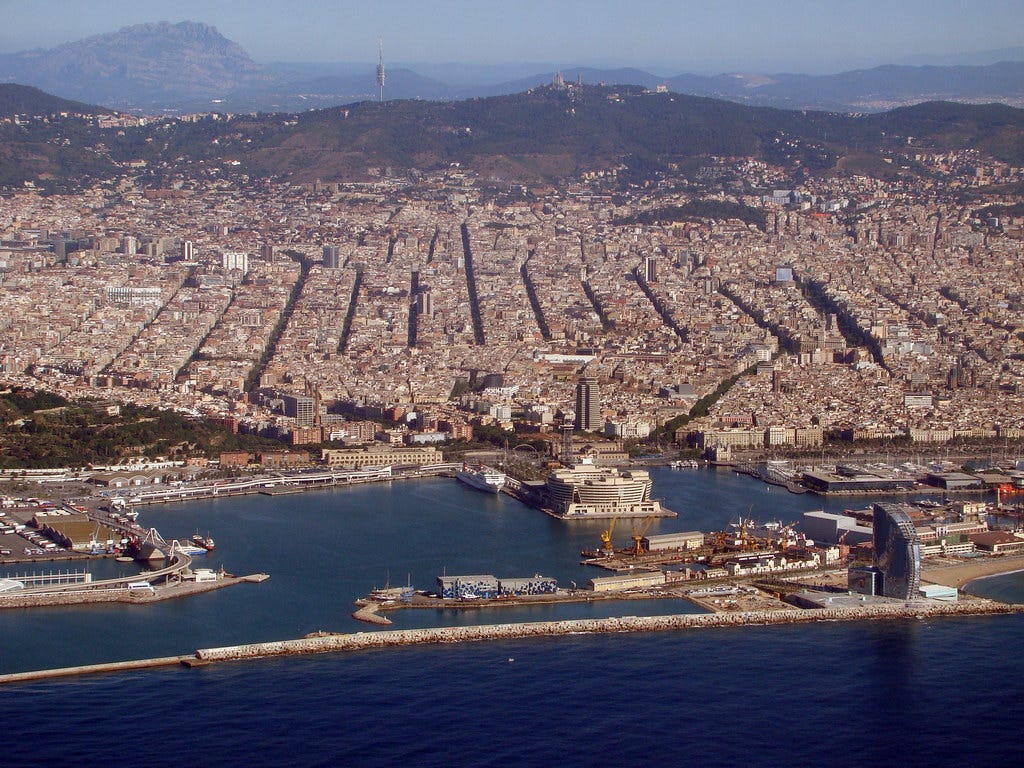
Here are three with a specificity I think you’ll love: a rambla is historically a dry or seasonally dry riverbed or irrigation runoff canal that people can walk in, with footpaths on each side. In the 19th century, rambles became paved road-complexes where the local petit-bourgeoisie would gather and stroll, though before urbanization they would be a more common thoroughfare for farmers, shepherds, and small merchants. (A note to tourists, la Rambla del Raval in Barcelona is a false rambla, constructed in the late 20th century to destroy poor and immigrant housing blocks and “open up” the neighborhood. Also: tourists go home, refugees welcome.)
A puig is a small street that goes up a hill and a baixada is a small street that goes down a hill. They might be so steep as to be pedestrian only. And no, they’re not one-way, and no, the Catalans are not unaware of the fact that a path that goes up a hill also comes down that hill. Here’s a hint: the reference point is the historic center of the town.
Whereas the half dozen words for “street” in American English now all mean the same thing, Catalan has at least 13 different words, synonymous but distinct, creating the possibility for a high level of architectural specificity. Calling a passeig a carreró would be like not having the words to distinguish an elephant from a mouse.
Word smooshing has political ramifications.
As far as I know, more resources have been spent disciplining the English language to restrict revolutionary possibilities than any other language, though Russian and Mandarin Chinese might also be in the running. To make matters worse, English contains several intrinsic vulnerabilities to word smooshing. For one, English is classified as an “analytic language” in terms of its grammar, which, to simplify greatly, means words are less tied in to their sentences and a priori more interchangeable. (Mandarin is also analytic, while Russian is synthetic.)
This feature is related to, and exacerbated by, the history of the language as a series of invasions: the Angles and Saxons, speaking a Germanic language, occupying a population that spoke various Celtic languages, then fighting and coexisting with Norse colonies where the ruling/military class spoke a different branch of Germanic; the Catholic invasion which brought Latin as the religious, scholarly, and legal language reserved for certain classes and spheres of life; the Normans, who spoke a langue d’oïl related to French but also inflected by some Celtic and Norse influences, taking over the tumultuous mixture already in place in Britain; further wars and occupations against the Celtic-speaking Scots and Irish. And all of this before English became one of the most prominent colonial languages that was also a site of key technological developments related to the global advance of capitalism.
English has had more practice than most languages at adopting new words. Some results of this are that English has a huge vocabulary compared to other languages, but many of these words are synonyms; English is notably polysemic; English is very open to word malleability, invention, and adoption.
Let’s unpack all that!
synonyms: words with similar meanings that aren’t always applicable in the same situations, like “create” and “invent” or “home” and “apartment”
polysemy: words that have multiple meanings, like “boot” as a type of shoe, the trunk of a car, or the verb for firing or expelling someone
word malleability: a grammatical and cultural norm that allows anyone to alter and adapt the meanings of words instantaneously, creating a new meaning (polysemic) after just a few uses, like “shade” as something that can be thrown or “frame” as to falsely accuse
invention: the practice, more normalized in English than in many other languages, of individuals or groups inventing new words like “luggage,” “twerk,” or “pwn,” that start in a subculture and may or may not become generalized
adoption: the practice, more normalized in English than in many other languages, of individuals or groups adopting words from other languages – adoptees might have to spend a few years in italics, or an eternity if they’re PhD words or phrases like a priori, or they might be quickly integrated, like “hummus,” “crag,” “parkour,” or “robot”
I put polysemy in bold because that’s an important one: many English words have multiple meanings that need to be inferred from context. Russian, for example, is much more particular, more monosemic: there’s less flexibility, and you need to choose the right word for the specific meaning the context demands. A consequence is that you can speak decent English with a small vocabulary, whereas you need a much higher operative vocabulary to get by in Russian. A consequence of polysemy is it’s easy to be a native English speaker who has expended very little effort to do language. But this also means there’s less motivation to get really good at the language. It takes a level of effort we’re not used to to avail ourselves of analytic precision or poetic transformation. And I know this contrast is real when I think of my Russian friends, from proletarian backgrounds, all. Keeping with the tradition of offering spontaneous, lengthy toasts at birthdays and other special occasions, these folks are able to deliver up a stunning eloquence—independent of their formal education—that makes me and other wordy English-speakers I know envious.
You might say—wait for it—that English fluency has a steep learning curve, whereas English mastery has a very gradual learning curve.
To summarize, we’ve got a bunch of words in English, many of these words mean similar things, and we’re ruled by wealthy evil overlords who want us to be stupid and who have designed an intellectually stultifying hellscape for us to inhabit. It’s inevitable that we will tend to forget the particularities and histories of our words, that we will waste much of our ample vocabulary on product choices and consumer culture, and and that we’ll participate in smooshing everything else into a simplistic, easy-to-manipuluate language that might as well be Newspeak.
It’s also undeniable, on reflection, that this is a tendency we can and must overcome.
In Part II, I’m going to be discussing the kinds of language loss that provide an archaeological record for how capitalism has exterminated entire ways of life. And in Part III, I’m going to get saucy and argue how we need to fight back against the slippage and misuse that is critically changing the meaning of really important words and terms like “performative,” “liberal,” “Left,” “radical,” and “intersectional.”
Excellent, thank you, Peter (two language nerds here, and I speak multiple languages, which made me very aware of language as an operating system and a box that you don't usually appreciate the limitations and ramifications of if you just have the one language).
We're in Australia and have been bemoaning the dumbing down of spelling, grammar and language use in our once standard-bearer of good literacy, our ABC, especially in the last 20 years (and possibly one of the results of political interference). Those unnecessary hyphens are now cropping up like a plague. Saying someone is "30-years-old" appears now to be journalistic standard, and "decimate" is used universally incorrectly these days as a synonym for "destroy utterly" when it actually means "to reduce by ten percent." All articles are now prefaced by a three-point summary, as if that is a valid alternative for actually engaging with a subject; not that there's that much engagement when the reading level has been stripped back to around age eight.
Language shapes our thinking and necessarily constrains our world views, so it's important to learn about the sorts of details you go into in this article. I'm looking forward to the subsequent instalments, especially the third!
From Australia we wanted to draw your attention to two excellent (but little known abroad) resources you might like. The first is a short and delightful Australian classic on exactly the subject you are discussing here:
https://www.penguin.com.au/books/death-sentence-9780143790983
The second is an interview with an Indigenous language speaker explaining how his language carries an entirely different (very intricate and fascinating) world view.
https://www.abc.net.au/listen/programs/allinthemind/indigenous-language-and-perception/11457578
Hope you enjoy. Greetings from a fellow anarchist.
Oh, I had so much fun with this! What do you call changing a word away from its original opposite meaning? I am non-plussed to hear people use this word as unsurprised. It really bugs me! And/ but as an editor who has removed superfluous hyphens, I can’t help but wonder whether insisting on order in language is antithetical to anarchist living.
I am quite looking forward to parts II and III. A bit of levity in addressing the important links between language and critical thinking will never go amiss!