
Independence Day Hangover
Hatin’ on the State with some Really Good Tunes

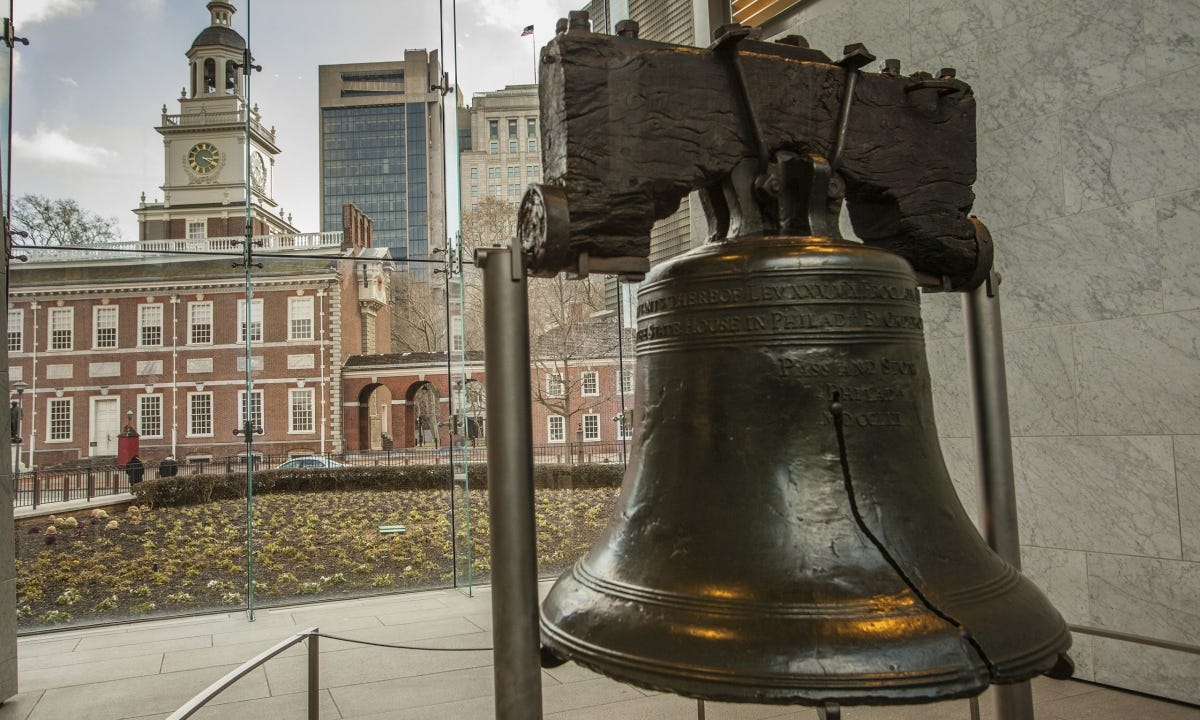
The Liberty Bell cracked the very first time the settlers who had paid to have it cast tried to ring it. So they melted it down, recast it, and tried again. Cracked. It’s hard to say if this was a sign of shoddy American craftsmanship—the preamble to a culture of prefabricated houses, cars that barely get 100,000 miles, and Happy Meals—or if it was the work of the millions of ghosts determined to demolish an ostentatious artifact that presumed to symbolize liberty on behalf of a country founded on slavery and genocide.
That’s not hyperbole.
Who were the people who led the American Revolution and what were their motivations? Who made up the ruling class of the new republic? I’ve written up a short essay answering those questions, and it comes with a soundtrack! Below that are a couple article and movie recommendations, and a new edition of 3TFs.
First of all, though, I wanted to send a huge shout out of gratitude to John A. and Samuel M.! As far as I can tell they were the first to take me up on my request. Svbstack is taking more and more of the money that’s meant to go to the writers, but you can support the work I do more directly through Paypal @pgelderloos or by gifting one of my books to someone you know, getting a local library or bookstore to stock it, or getting me invited to talk at a university with a speakers’ budget. (And if you go for one of these latter options, let me know in the comments or DMs!)
Sedition Act Soundtrack
So. Let’s start with a surprise. I want to name something great about America: the music made by the people rebelling against racial capitalism and patriarchy, against consumer culture and the prison society, people descended from refugees and immigrants who are just trying to get by.
I’m not on Spotify anymore because of their especially bad politics and how little they pay the artists, but you can find this playlist on Tidal. It’s called “Sedition Act,” username @arrojalabomba
And if you don’t have Tidal, here are the songs!
Nina Simone, “Mississippi Goddamn”
Gil Scott-Heron, “The Revolution Will Not Be Televised”
Janelle Monáe ft. Saul Williams, “Dance or Die”
Ani DiFranco, “Amazing Grace”
Ennio Morricone, Joan Baez, “Here’s to you”
Bonnot, M1, Dead Prez, “Real Og”
Sepultura, “Slave New World”
Rage Against the Machine, “Sleep Now in the Fire”
Strike Anywhere, “Lights Go Out”
Bob Dylan, “The Times They Are A-Changin’”
Phil Ochs, “Love Me, I’m a Liberal”
Against Me!, “We Laugh at Danger (And Break All the Rules)”
Pete Seeger, “Solidarity Forever”
Woody Guthrie, “I Ain’t Got No Home In This World Anymore”
System of a Down, “Prison Song”
Public Enemy, “Fight the Power”
Mr. Lif, “What About Us?”
Kendrick Lamar, “Alright”
Propagandhi, “The Only Good Fascist Is a Very Dead Fascist”
Lil Boosie ft. Webbie, “Fuck the Police”
Woody Guthrie, “Tear the Fascists Down”
Against Me!, “Baby, I’m an Anarchist!”
Pete Seeger, “Which Side Are You On?”
Peter, Paul & Mary, “Where Have All the Flowers Gone”
Otis Redding, “(Sittin’ On) the Dock of the Bay”
The first president, George Washington, was the leader of the Continental Army and the richest man in North America. His wealth came almost entirely from slavery and land theft. One of the largest landowners in the Virginia colony, he enslaved Africans and their descendants and forced them to work on his plantations. He was proud of the Algonquian name his great-grandfather had won by carrying out acts of genocide against the Doeg and Susquehannocks people (including murdering Susquehannock leaders under flag of truce). The name was Conotocarious, which means Town Destroyer or Devourer of Village. The Seneca applied their version of that name, Hanödaga꞉nyas, to George W. after he ordered the total destruction of 40 towns of the Six Nations during the Revolutionary War. (Several of the Six Nations had allied with the British because the American settlers were even more voracious than the Brits in their appetite for land and murder.)
The second president, John Adams, came from a family of doctors and artisans in the Massachusetts colony. He went to Harvard and became a lawyer. Adams and his son, John Quincy Adams, were the only two of the first twelve presidents not to be slave owners and human traffickers. Before the Revolution, John Adams served as a lawyer for a group of British soldiers who had massacred a group of lower class protesters who were throwing snowballs at them. Using many of the same arguments that are still used today to allow cops to kill people, Adams got most of them acquitted. As President, Adams aided and encouraged the westward invasion of settlers through the Cumberland Gap, and passed the Alien and Sedition Act, which allowed xenophobic border and deportation policies and allowed the punishment and imprisonment of journalists and regular people for espousing opinions the federal government deemed to be revolutionary or seditious.
The third president, Thomas Jefferson, was another slave trafficker and plantation owner. He raped and impregnated at least one of the people he enslaved, and as President he promoted an expedition to the Pacific Ocean and with it, he promoted the idea that the new nation should conquer the entire continent, erasing or subjugating all the people who already lived there. He also started an international war, invading North Africa (the so-called Barbary Coast) under the racialized pretext that the Arabic/Muslim state that was collecting tariffs there, the same as the US collected tariffs, were simply “pirates.” Jefferson was the very first architect of a systematic policy of “Indian Removal,” or the forcible seizure of native lands and the eviction of all inhabitants to a frontier territory. He also supported the forced cultural assimilation of Indigenous peoples, to help them progress from “savagery to civilization.”
In a letter to William Henry Harrison, who became the ninth president on the basis of a successful genocidal war he waged against native peoples, Jefferson detailed a clear policy of land theft, genocide, terrorism, and the white supremacist belief of Manifest Destiny:
“Should any tribe be foolhardy enough to take up the hatchet at any time, the seizing the whole country of that tribe, and driving them across the Mississippi, as the only condition of peace, would be an example to others, and a furtherance of our final consolidation.” [in Rockwell, Stephen J. (2010). Indian Affairs and the Administrative State in the Nineteenth Century. Cambridge University Press.]
The fourth president and primary author of the Constitution, James Madison, came from another wealthy Virginia family that owned one of the largest tobacco plantations in the central region of the colony/state. Though he professed Enlightenment principles, Madison continued to be a slave owner throughout his life, making his money from their forced labor. As President, he helped the expansion of slavery, doing nothing to limit it. He also started a war with Britain, launched a failed invasion of Canada, and waged a brutal war against the Shawnee, Miami, and other native peoples who had formed a confederation to stop the influx of settlers. Madison’s campaign allowed the accelerating invasion of the Northwest Territories, particularly the land that would become Ohio, Kentucky, and Indiana.
The fifth president and the last of the “Founding Fathers” to sit in the White House, was James Monroe. Monroe was another Virginia slave owner descended from a wealthy family, who received an elite education at the College of William and Mary. As president, he invaded Florida to wage war against the Seminole, who were conducting a successful guerrilla resistance against the southern US slave owners, in collaboration with enslaved Africans who knew that the Seminole territory was safe haven for them. Through war with the Spanish, Monroe forced them to renounce their claims to a huge part of North America. He then annexed that territory, opening the way for an expansion of slavery and the plantation system and opening the gate for genocide against the Cherokee, Muskogee, and other peoples.
Prior to 1775, there had been numerous rebellions by a mix of Indigenous, lower class European, and diasporic African peoples, often working together and creating their own societies of resistance and solidarity at the edges of the colony. At their best, these were rebellions against white supremacy, capitalism, and state authority. And the Founding Fathers, their parents, their grandparents, and their great-grandparents, took the side of profit, law, and whiteness, helping to repress these rebellions. Multiple historians, like Rediker and Linebaugh, argue that they launched their own political revolution to prevent the social rebellion that was brewing amongst the oppressed.
But we can also take their own words to heart: they believed that the merchants and landowners of the colonies (all wealthy white men) could rule the continent better than the absentee governors and landlords in England; they objected to British taxation (which was overwhelmingly a concern for landowners and merchants); and they objected to the British alliance with certain native peoples, referred to in the Declaration of Independence as “merciless Indian savages.” It had long been a complaint by the settler colonists that the British tried to establish limitations on land theft. For the British, their practice of establishing alliances and borders with Indigenous peoples was simply to prevent unexpected wars from arising as they juggled Empire on a global scale. They routinely violated those borders to steal more territory, but at moments of their choosing. The British also needed to protect their alliances with certain Indigenous peoples who frequently helped them fight their colonial rivals, the French. And in exchange for the firearms they needed to survive in a situation of accelerating colonization, Indigenous allies were made to fuel the colonial economy, for example by participating in the fur trade.
To the American settlers, though, these alliances were an insult to God and nature. God had placed all the land there for white people to take, without any border or limitation.
Since then, things haven’t gotten better. Not a year has gone by when the US government did not conduct military action against another country. They invaded all the land from the Atlantic to the Pacific, and then they took over Alaska, invaded the Philippines (and murdered hundreds of thousands of people), invaded Puerto Rico, invaded Hawai’i, invaded Colombia, invaded Korea, and they’ve never stopped, apologized, or given any of it back.
They never abolished slavery, they just changed what it looked like. Forced labor in the prison system for about 1% of the population, and an intentional system of land ownership, exploitation, and low wages to keep half the population in a situation of dependency on working for the wealthy, with no possibility of accumulating wealth of their own and achieving intergenerational stability.
Dispossession, exploitation, and erasure at the most fundamental levels is baked into the system for Black and Indigenous people. And for other racialized people and white people, the United States has always mobilized severe repression against all those who fight against the allegiances of whiteness, or who fight against the wealthy and powerful.
The land is beautiful and vibrant. The cultures, music, and food of the marginalized is amazing. The rebels and revolutionaries deserve our admiration and support. It’s those who occupy this land and those who worship them who are our enemies. And not for any ideological reasons. Just because they are committed to war against any who do not obey them or play along in their sick game of domination and profit.
This war has been going on for a long time. We need to be aware of it and able to fight it. We also need to be able to find moments to enjoy life, to play, to keep our breathing easy and our minds sharp. On that note…
Here’s the next edition of 3T/Fs.
Below are three statements. They might all be true, they might all be false, they might be a mix. To play, place your answer in the comments (in the format TFF, FFF, FTF, etc.) and when I publish the next round of the game, I’ll share the answers for this round. And below, you can find the answers from the June 17 edition.*
Gymnastics and gymnosperms (the class of trees that includes sequoia, redwoods, and fir trees) share a common root because they both refer to climbing to impressive heights.
Your chance of correctly calling the toss of a 6-sided die 5 times in a row is 1 in 15,625.
You did it! Somehow you have managed to correctly call a 6-sided dice toss 5 times in a row! Now, try to call it again. On this 6th toss, your chances are actually much better.
What do you think? Leave your guess in the comments!
“When Adam delved and Eve span, who was then the gentleman?” was an early anticapitalist slogan.
For all their differences, “Catholic” and “Unitarian Universalist” mean pretty much the same thing.
Calculating the volume of a cube is simple. But it seems pretty much impossible to come up with a single equation to calculate the volume of an irregularly shaped object. Historically speaking, take a bath and maybe the solution will come to you.
These are, actually, all true.
TTT.
The couplet in first statement was devised by the heretical priest John Ball to argue that God never intended humanity to be divided by rich and poor, by nobility and commoners, because in the Garden of Eden and afterwards, humans were equal. Interestingly, Ball refers to Adam and Eve as laborers. Adam is digging, in order to plant crops, and Eve is spinning, in order to make clothing. This means that, A) this was after they had been expelled from the Garden, and B) heretical commoners in 1300s Europe idealized workers without bosses and understood that, despite gender roles, men and women were workers, and equals. In later centuries, when patriarchy was becoming more powerful, upper class bootlickers argued that hierarchy and aristocracy were natural, since in the Garden of Eden God had created woman to serve man. Clearly, though, many Medieval Christians understood them as equals. Now, some readers might make the argument that this was not an anticapitalist slogan since capitalism did not exist yet in the 1300s. Regardless of the birth date we place on capitalism, though, anticapitalists in later centuries certainly remembered and quoted John Ball’s ditty.
This is true only because “Catholic” literally means “universal” and was intended to be a unifying, all-encompassing name for the Christian religion, though of course over 1000 years of schisms have ended those pretensions. But speaking of schisms, there’s a new one! The American pope just excommunicated 4 far-right bishops in Switzerland for getting ordained without his permission. They belong to a sect with tens of thousands of followers. We’ll see if this sets off a bigger split between the homophobic, patriarchal, and big business Catholics and the ones with more sympathy for liberation theology.
Humans have been working on this problem for over 2000 years, and there is still no simple equation for calculating the volume of an irregularly shaped object the way there is for calculating the volume of a sphere or square. There is, however, a simple method, developed by the ancient mathematician and engineer Archimedes. The story is that he had been commissioned to discover the density of a valuable object, and calculating the density also meant measuring the volume. The problem flummoxed him, since, like I mentioned, we still don’t have an equation for this. Taking a bath, though, he saw how the water rose when he slipped in, meaning the volume of his body was displacing water. Thus, in a measured container, it is a simple thing to find out the volume of water that an object displaces, and this number will be the same as the volume of the object itself.
One engaged reader objected this last point didn’t have an answer since it was not written as a question. That is true, but also, none of the points are written as questions. As stated in the rules, these are three statements, not three questions, and each of them is true or false.
Still, this reader gets a point, because I want people to push against the rules, question interpretations, or suggest alternate answers!
I’ve got to get back to work, so that’s all I have time for today. I’ll close out with a recommended article by Margaret Killjoy on trans people and sports.
And, if you need to get your mind off the world for a minute, here’s my official recommendation for an excellently made recent movie, Tuner, and for a 2018 movie I just came across, Game Night, which nails the mystery genre, has great acting, and is good for a lot of laughs.
3TFs!

Below are three statements. They might all be true, they might all be false, they might be a mix. To play, place your answer in the comments (in the format TFF, FFF, FTF, etc.) and when I publish the next round of the game, I’ll share the answers for this round.

TFF
Learning a lot through this game! Not sure it'll stick in the memory but anyways...
Great essay too
fff !