
Don’t Talk Like That
how nation-states destroy the diversity of languages

they also destroy the diversity of food systems and ecosystems! check out this episode of The Poor Prole’s Almanac, where I talk about forest gardening vs. the monocrop plantations of the modern capitalism
In a recent newsletter, my friend Ricard talked about how the French state has recently prohibited the use of the Catalan language in four different municipal governments in North Catalunya. It’s not the first effort to kill off the language, he noted. Already in 1700, Louis XIV prohibited the use of Catalan throughout his kingdom and legally required mothers to speak to their children in French. But what is North Catalunya and why do they speak Catalan there?
North Catalunya, which includes the county of Rosselló and the city of Perpinyà (Roussillon and Perpignan, in French) has been occupied by France since around 1659.
Prior to that, North Catalunya belonged to the principality of Catalunya (which was largely autonomous, but adhered to the crown of Aragón), to the Kingdom of Mallorca, and for two and a half centuries straddling the year 1000, it was ruled by the Count of Rosselló. Before that the territory was part of the Carolingian empire started by Charlemagne, King of the Franks (a partially latinized Germanic tribe). Before that it was depopulated for around half a century during wars between Visigothic warlords and the Emirate of Córdoba, and before that…
Here’s an interesting fact that might jump out: we’ve just listed all the different political authorities that have ruled a territory in the middle of Europe over the course of a thousand years, from the early medieval period well into the beginning of the modern era, and in that entire time we’ve only come across one state that is recognizable today as a country: France.
In 1659, France existed, as did England and several other entities we would refer to as countries today (Poland, Sweden...) but Spain did not exist, Germany did not exist, Italy did not exist… Certainly, an outsider in 1659 might have referred to Spaniards, Germans, and Italians, though these terms would have often had less weight for outsiders, and far less weight for insiders, than Castillian, Galician, Sevillan, Saxon, Bavarian, Hessen, Genovese, Venetian, Napolitan…
Here’s another important feature: in the thousand year summary above, very few states correspond to languages or peoples. This shouldn’t be a surprise, since a feature of modernity was the invention of nation-states – a people, ruled by a common government, speaking a common language, held together by recognized borders. Every nation-state is a fiction, but it is a fiction made real through state policy. A state or proto-state that tends to comprise a more or less stable, coherent conglomeration of military and religious hierarchies conquers the territories of their neighbors, as states do. But rather than just collecting taxes and tithes or imposing a more “productive” (exploitive and extractive) economic model to keep their state apparatus going, they also impose their language and religion, from the upper classes to the lower. Eventually, they create the false idea that the captives living within the borders created by force all share the same history. They are “a people.” (Note that this is a very different concept of people, and a different method for creating a people, than the concept common amongst Indigenous and other stateless societies, in which belonging is often voluntary, someone might belong to multiple peoples, and different peoples are not separated by borders.)
I knew all this, and still I was surprised when I did a little research into the linguistic history of “France” and found out how brazen the lie actually, how slow and incomplete the process of fabricating a national language and imposing it on an entire captive population.
The French language is a direct descendant of the dialect developed in Ile-de-France, the region containing Paris. It’s a bastard tongue cobbled together from elite Latin and vulgar Latin, the several romanized Germanic languages spoken by the Frankish tribes, and probably with some Celtic influences as well from the peoples who inhabited Gaul when the Romans colonized it. Just one of a hundred languages spoken by those who live in what we now call France.
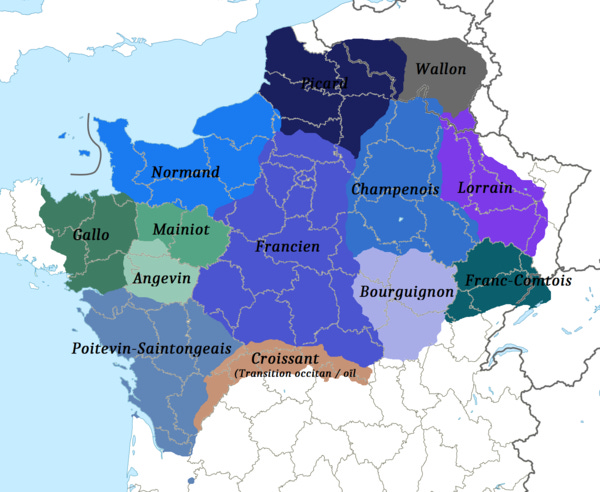
According to the Prime Voices blog, before the revolution of 1789, French was the language of only about 10% of the population of France. The Revolution was initially tolerant towards linguistic diversity, but soon decided to:
‘extirpate the coarse languages that prolong the infancy of reason and the old age of prejudice.’ In other words, the patois or dialects had to be eliminated. Speaking French was to strengthen democracy; forgetting dialects was to free oneself from domination and dependence.
The French linguistic terror did not succeed. Besides the resistance of the population, the destruction of churches and convents ended up destroying schools and colleges, while the state had no means to open republican schools with French teachers.
According to another article, around 1789, 30 different patois, dialects, or completely other languages were spoken in French territory (not including overseas colonies or foreign soldiers in the French military). Nearly a quarter of the population was estimated to be completely ignorant of French and another quarter unable to hold a conversation in French.
This included one million speakers of Breton (a Gaelic language like Irish), 100,000 Basque speakers (one of the oldest language groups in Europe, completely unrelated to Indo-European languages1), 100,000 Catalan speakers, one million speakers of German (itself not yet a unified language, and most of them living in territories like, for example, Alsachsen, which has been Frenchified as “Alsace.” Such regions had changed hands after wars of conquest against different German-speaking polities (not wars against Germany, since, remember, Germany did not exist yet in the 18th century),
This linguistic diversity was of particular concern to the Revolutionary governments who saw France as a single unified entity. This ultimately led to a sort of linguistic nationalism. As the Jacobin grammarian Francois-Urbain Domergue wrote: ‘As children of the same family, we must have the same thought and be moved by the same sentiment,’ adding that ‘it is very hard to be united by opinions when you are separated by language.’ Gregoire in his Rapport wrote hopefully of a future ‘epoch when these feudal idioms shall have disappeared.’ Bertrand Barere, a member of the Committee of Public Safety, less charitable, said (in his speech of 8 Pluvoise Year II) that federalism and superstition spoke Breton, emigration and hatred spoke German, the counter-revolution spoke Italian, and fanaticism spoke Basque, adding, ‘Let us break these harmful instruments of error.’ In 1794, St.-Just had dreams of resettling the German-speakers of Alsace to central France in order to ‘Frenchify’ this border region. The Alsatian towns would be renamed for soldiers who had died fighting for the Republic.
The most famous Frenchman before the 20th century, Napoleon, didn’t actually learn French until he was 15. His language was Corsican, which is much closer to Italian (which, also, is not actually a single language).
The PV blog again:
“in 1810, French was spoken in only 25 departments or territorial divisions out of a total of 130.
“By the mid-19th century, 7.5 million French people, or 20% of the population, spoke French fluently.”
“In 1864 the minister of Education found that in 18 French departments 60% of the population did not speak French.”
“despite efforts to suppress regional languages, several of them are still spoken in certain areas of France. For example, Breton is still spoken in the Brittany region, and Alsatian in the Alsace region. Corsican is spoken by more than 100,000 people on the island of Corsica. Basque or Euskera is spoken by about 50,000 people in the southwest of the country, while it is estimated that Catalan is the language of about 60,000 people in the Occitania region.”
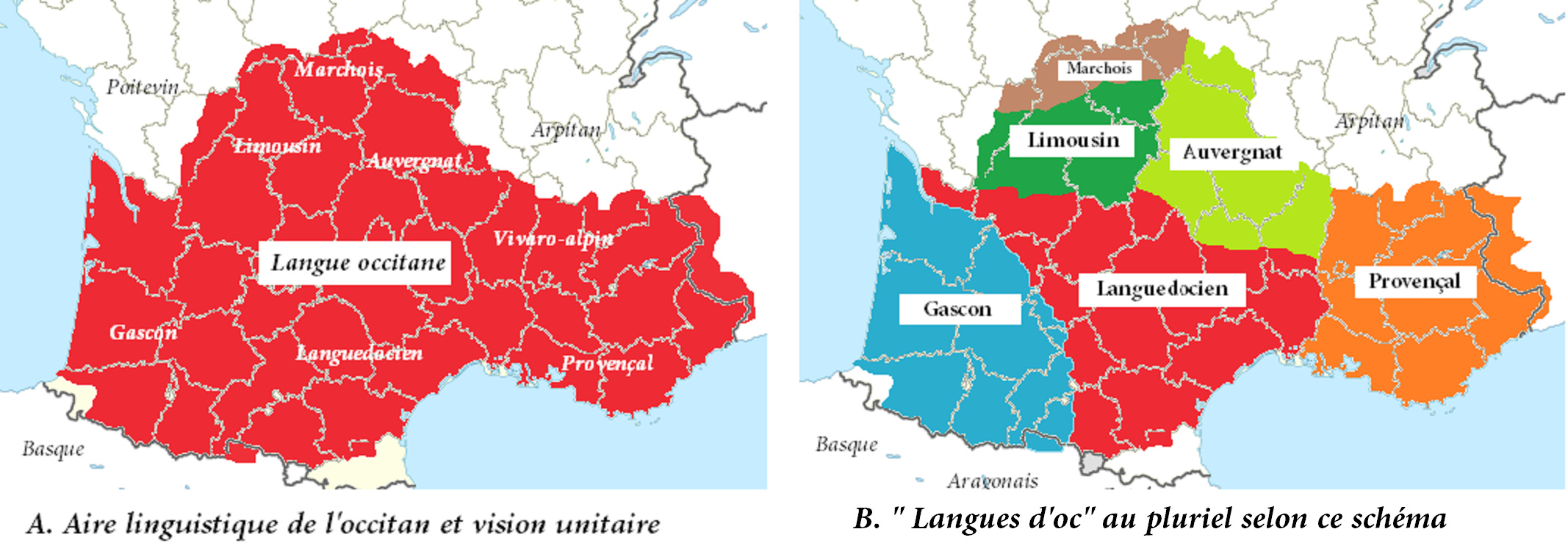
The white spaces on this and the above map contain the territories, claimed by France, where the primary language (at least, primary until the 20th century) is Basque, Catalan, Breton, German… and all of these maps leave out other cultural/linguistic groups like the Rromani, who have lived in these territories for close to a thousand years, and large immigrant populations that include captive subjects from French colonies or refugees fleeing famine and war — in many cases famines or wars the French upper classes profited from.
Nation-states produce linguistic flattening
It’s interesting, in the history above, how democratic and anti-monarchic movements, movements that believed in progress (another bloody fiction), were instrumental in crafting systematic plans for inventing a national language and suppressing other languages. It’s also key that government repression of other languages accelerated at a time when the French colonial empire was expanding and a growing number of colonized subjects were emigrating from Africa, the Caribbean, and southeast Asia. The fiction of a national language was attached to the wars of colonization, a war waged by European nation-states against the entire planet. An official national language is a primary ingredient for the fictional nation-state, and it also lends itself to various strategies of white supremacy and racial hierarchy.
National languages are achieved through a combination of hard and soft tactics.
The hard tactics include:
militarily defeating and conquering another population
killing, enslaving, or forcibly displacing the speakers of another language
forcing the speakers of another language into a lower economic class, stealing their land, etc.
punishing those who speak the non-official language
prohibiting the use of other languages in official setting like courts or in the media
The soft tactics include:
creating status hierarchies and education systems that portray other languages as ignorant, backwards, lower class, or unmodern
rewarding integration into the official language through greater access to cultural status and employment opportunities
linking stable government jobs or higher paying jobs to the national language and linking low paying service, agricultural, and manufacturing jobs to “dialects”
creating bureaucratic obstacles around the use of the other language in day-to-day life
and more recently, promoting tourist economies where high income visitors are led to expect that local service workers will speak the national language and possibly also a cosmopolitan/colonial language (English, Spanish, French, Russian, Chinese)
The process is not as violent when we’re dealing with the languages of non-colonized people, people who aren’t facing genocide, conquest, or imprisonment (like the Palestinians, Ukrainians, Uighurs, and Indigenous peoples across the Americas are).
Still, even in the absence of an open war, the smothering of a language is a brutal thing. And it’s a brutality that cannot be imagined by those who only speak a language that is not in danger of disappearing, a language that thrives today because it has a powerful state that backs it, a nation-state that, in the interests of power, has destroyed a dense network of diverse languages in order to build a monoculture. Easy to rule, easier to surveil.
Linguistic oppression is real, in its own right and as a facet of colonialism, which has produced some of the most brutal oppressions in our history. So what does linguistic liberation look like?
In a future essay, I want to look at how national liberation is no solution, at what linguistic liberation could look like in a non-colonial context, and what it looks like in a colonial context.
If you want another way to support my writing work, consider gifting someone a book from an independent bookstore like Red Emma’s or Firestorm or paypal @pgelderloos
Until next time, take care of each other .

Indo-European is a language family that includes hundreds of languages spoken by around half the planet’s population, from Sanskrit, Pashto, Persian, and Kurdish to Swedish, Irish, Polish, and Spanish. Speakers of early Indo-European languages migrated into Europe about 4500 years ago, sometimes displacing and sometimes living alongside earlier populations. The only language remaining in Europe from these earlier populations is Euskera (or Basque).
« Adishatz ! » (Hello :) ), I’m a Gascon (a french “citizen”), and I want to thank you for this article, hopefully it will help my international friends understand why I’m relearning my grandparents’ language, as well as raise awareness abroad.
You did a great job explaining what happened in a nutshell. People usually can’t believe me when I tell them France has tens of languages. Relearning it means growing past the shame, the scorn, the humiliations. In the 60’s and 70’s, people stopped teaching their own language to their kids, after generations of punishment and shaming in schools and elsewhere. It took me years to accept that it’s not ridiculous and useless to know our language. That’s how far the endoctrination goes. And that’s why we have a generational gap where almost all elderly people speak the language while people in their 40s don’t. They are what we call “minorized” languages, as in languages that were majority but have been suppressed into minority. Our languages are terribly hurt and might never recover, they may die in a generation. However I want to be part of those who resisted and got conscious of the importance of saving them. And also fuck empires, we won’t go away silently. And we might even win.
You didn’t mention the Occitan languages (besides the map), of which my Gascon dialect is part : we are usually overlooked in favour of Basque or Breton. And I know why you’re interested in Catalan (wink). But we are by far the biggest chunk of the suppressed languages. Here, there is a revival movement with literature, radios, bilingual schools. The French state is actively suppressing us though, with no official recognition in sight and lack of any sort of financial support. It is still considered an outrage against the republic to be using any other language than French in the public spheres. The scorn from the Paris elites is as high as it’s ever been, it’s even accompanied now with complete ignorance of any diversity : the intellectual elites don’t even know about us, because we’ve become so insignificant they don’t need to.
And thank you so much for connecting that oppression to colonisation, nobody wants to believe it. All they care about is borders, so if it’s inside the French state, it’s not colonising. Why isn’t it the same? An outside power came and destroyed our culture.
Also, I want to mention that in the case of Occitans (Gascon, Langadocian, Provençau, Lemosin…), the revival movements are mostly left-wing : inclusive, cultural (not ethnic), anti-nationalist, often anti-state (we’ve learned by necessity to abandon all hope in the state) and often radical. And I’m so grateful for that because many basques or bretons or corsicans just want another border. Keep an eye on the Occitanists :)
Hi Peter! I'm not an expert on the matter, but I'm born and raised in Sardinia and this topic hit close to home. We Sardinian as a people have been colonized (and tried to) for a long part of our history and even if we're considered part of Italy we don't really feel that way (not many of us at least). Our autochthonous language has been deprived of its use, flattened and fought with the same patterns you mentioned in your article and it has been really damaging for our culture and identity (and yeah, that's colonization) I also wanted to say that Sardinian language is actually very ancient and some experts consider it pre-indoeuropean exactly as Euskera. I thought you might be interested!